


TECHNOLOGIES
MicroLED for the Interconnect Era
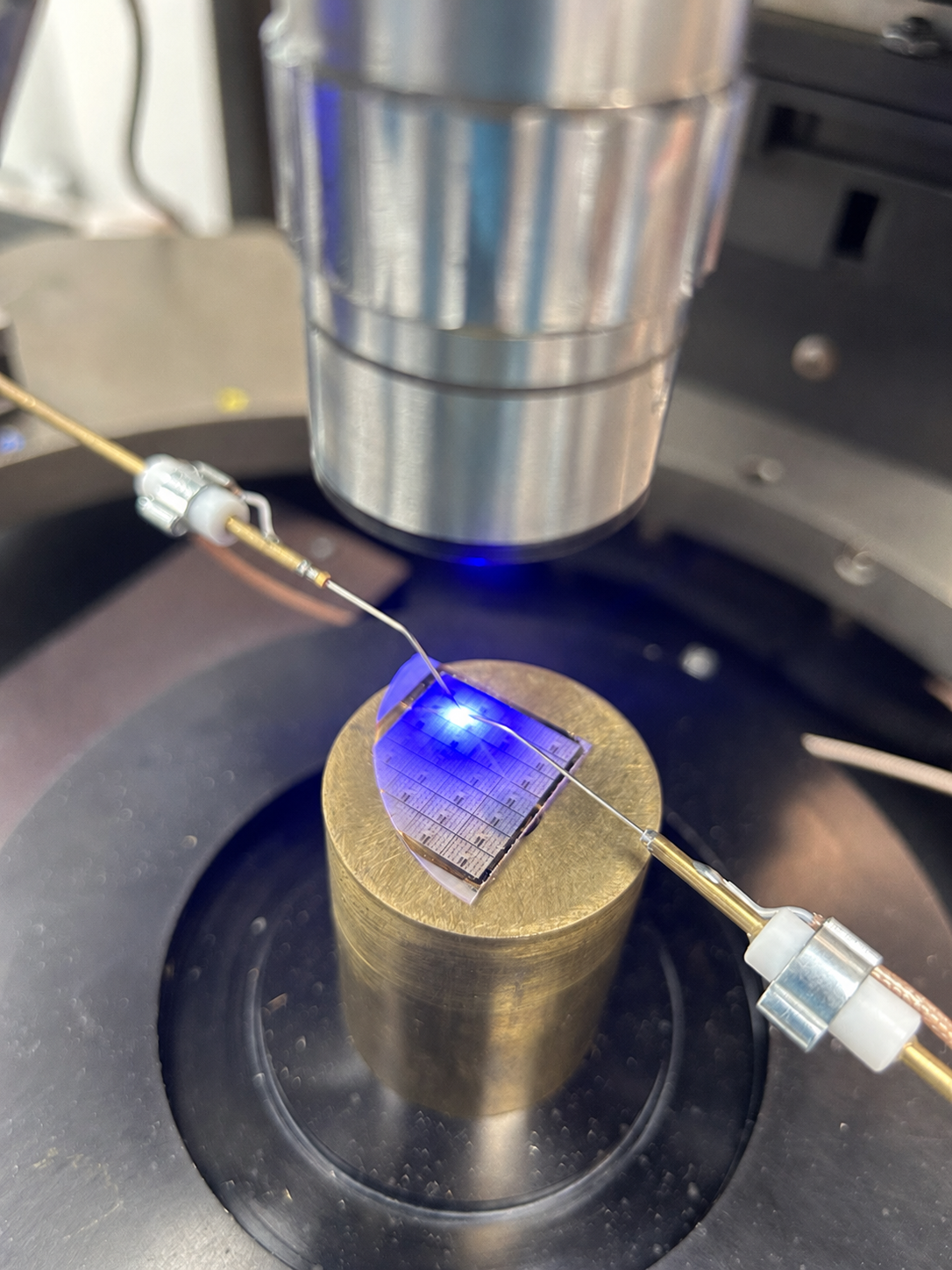
When bandwidth density and integration matter, the emitter matters. Palomino’s MicroLED foundation is built for optical links that need a credible path from architecture to deployment.
Why MicroLED for interconnect
MicroLED opens a scaling path for optical interconnect where size, density, and power constraints keep tightening. It is a platform for building compact optical engines without treating integration as an afterthought.
Palomino’s MicroLED foundation
Palomino started at the source: MicroLED device and integration fundamentals designed to support real link architectures. That foundation underpins how we evaluate trade-offs across chips, modules, and full optical links.
Optical interconnect advantages
At scale, electrical links pay a growing tax in loss, equalization, heat, and complexity. Optical interconnect shifts the bottleneck and enables bandwidth growth with cleaner system behavior.
Integration potential
Integration is what turns a technology into a product. Palomino focuses on architectures that can be packaged, assembled, and scaled into deployable optical links, not just demonstrated.
Use cases
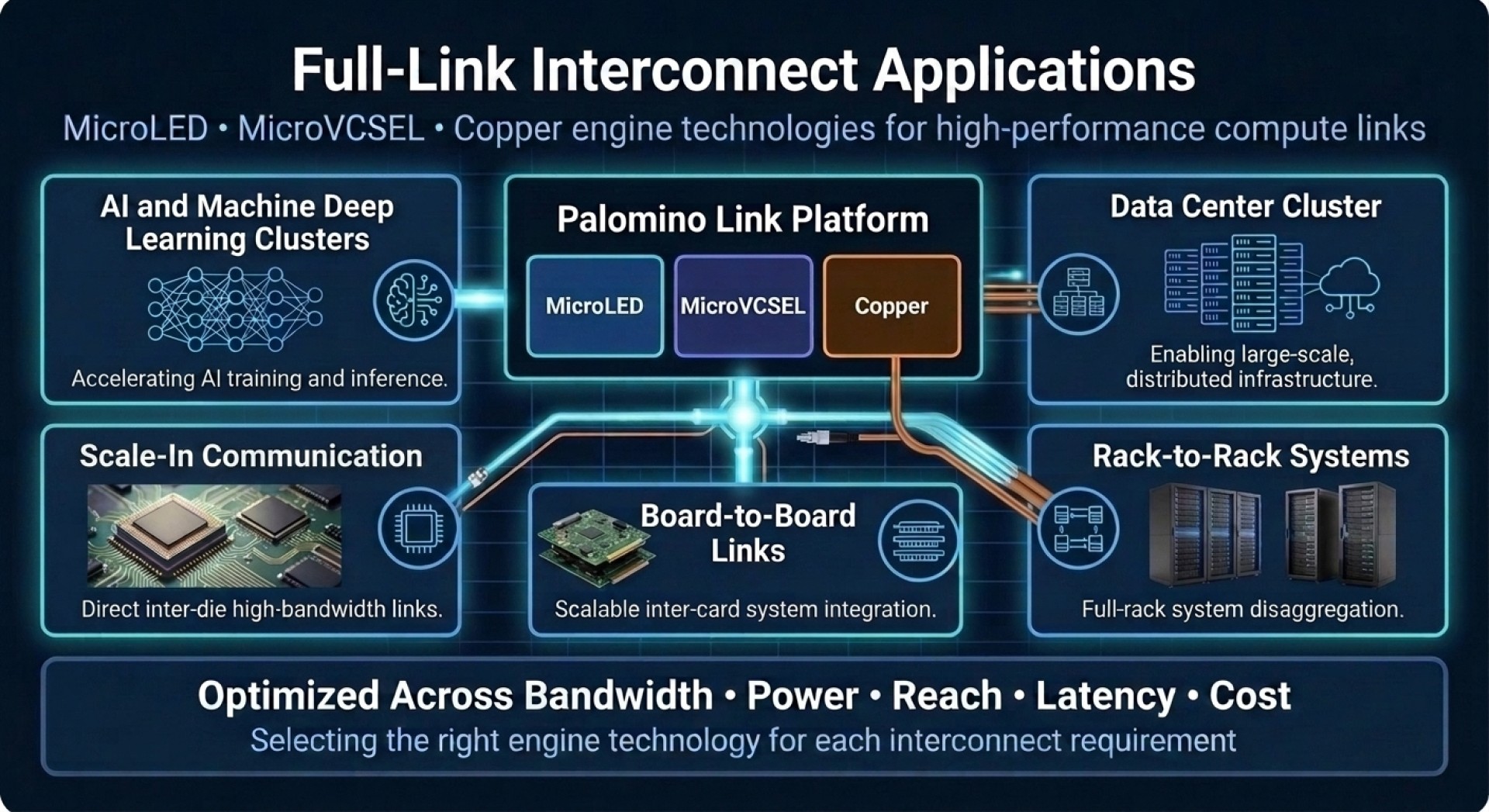
Built for teams designing next-generation interconnect across data center systems such as Scale-Up or Scale-In, OEM platforms, and hyperscale environments where bandwidth density, power, and footprint collide.
Ready to pressure-test your link architecture?
MicroVCSEL: A Complementary Optical Engine
MicroVCSEL strengthens the link portfolio where proven optical architectures and pragmatic deployment paths matter. Palomino will develop silicon IC’s to support MicroVCSEL based modules and full link solutions.
Why MicroVCSEL
MicroVCSEL fits optical communication needs that prioritize manufacturable architectures, predictable integration, and performance that maps cleanly into real systems.
Where it fits in the link portfolio
No single emitter wins everywhere. Palomino positions MicroVCSEL alongside MicroLED so architects can choose the right engine for the link constraints: distance, density, power, cost, and integration timeline.
Benefits for optical communication
MicroVCSEL-based approaches can deliver a strong balance of efficiency, scalability, and integration practicality for optical communication in modern compute environments.
How it complements MicroLED
MicroLED can target aggressive density and integration paths. MicroVCSEL can serve architectures where deployment pragmatism and ecosystem alignment drive the decision. Together they expand the number of links Palomino can enable.
Want a straight answer on which engine fits your link?
Copper still wins in the right places
The best systems are hybrid: copper where it is fastest and cheapest, optics where scaling forces the move. Palomino builds for commercial reality, not slides.

Copper remains the default for a reason: cost, simplicity, availability, and fast integration. For many short-reach connections, it is still the best total system decision.
Where copper wins
Copper wins when distances are short, budgets are tight, and deployment speed matters more than pushing the next bandwidth frontier.
Hybrid optical and electrical link strategies
Modern architectures mix link types to optimize performance per watt and performance per dollar. Use copper to keep systems simple where it works, then apply optics where electrical complexity and power grow too costly.
Cost and deployment advantages
Copper’s advantage is not just BOM cost. It is qualification burden, supply chain depth, serviceability, and operational familiarity. Any optical roadmap that ignores that loses in the real world.